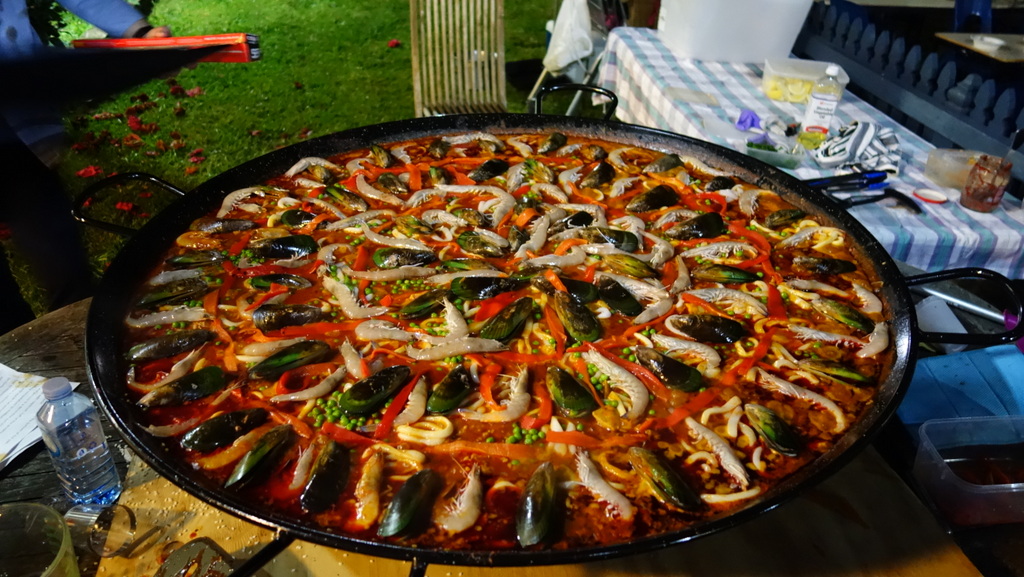
Paella for a crowd - 100, 75 or 60 people


A paella recipe for 100 people including chicken, pork and seafood. It is made in a 115cm pan which is actually large enough to feed 120. I've also included quantities for 75 or 60 at the end. The method is the same.
This is a performance dish, and people want to stand around to watch and talk. This increases the level of difficulty but it’s important to provide a welcoming presence. That is what it’s all about, after all.
You could provide extra implements for people to get involved in stirring the pan.
As soon as you complete one step, prepare to do the next.
It takes around 2 hours from the time you light the flame till you are serving the paella.
Note that when serving you mentally divide pan into eights with each eighth feeding 12.
At the bottom of this page is a table showing pan and serving sizes.

Ingredients

10kg chicken thighs, diced. Have a chicken shop dice them for you.
5kg chorizo, cut into ½ cm slices
5kg medium green prawns – some in rice, others on top for decoration
3kg mussels in the shell
2kg calamari, cleaned and sliced (I use frozen)
3 heads garlic, chopped
10 tbs chopped parsley
2.5kg red peppers from a jar.
2kg frozen green peas
12 lemons, each cut into 8 pieces
8kg of paella rice either bomba or calasperra rice
100g smoked paprika
Saffron, as much as  you can afford. Puree in a spice grinder with sugar, pour over a little boiling water and allow to stand at least 30 minutes.
400g tomato paste
1-2 cups brown sugar
1.5 litres olive oil
24 litres chicken/seafood broth
Salt to taste

To do before

Chop garlic finely
Dice chorizo
De beard mussels
Puree some red peppers, slice the remainder for decoration
Chop parsley
Make up saffron mixture

Equipment

Paella pan at 115cm in diameter, usually available for hire
Gas ring to heat the pan, available when you hire the pan
Wind shield for the burner
2 tables - one for the paella and another for ingredients etc
Spirit level to check the level of the table
Wedges of newspaper to balance the paella table
Alfoil to cover the pan. About 7 metres
Strong implements for stirring
Separate bowls for each ingredient
2 strong metal serving spoons
4 oven mitts to hold the pan to shake it
Scales to measure smoked paprika
Camera
Recipe printed out
Pen
Scissors for opening packets
Light for the table
Garbage bin
Apron

Method

Be prepared for people to watch you!
Make sure pan is level
Heat pan with the flame as high as it can go
Add chorizo, fry and remove
Heat some oil
Add prawns, fry briefly and remove
Heat some more oil
Add chicken and fry for about 10 mins or until cooked. Remove from pan.
Add more oil and then garlic, pureed paprika, sugar and tomato paste.
Reduce this (it's called the sofrito) until thick and dark. Don’t skip this step. It affects the flavour.
Pour in broth and saffron liquid. Add salt to taste. (With large quantities of paella you add the liquid before rice)
Bring to boil, leaving the flame high.
Add half the parsley.
Add rice and stir to combine.
Reheat. Stir rice. (Many recipes will tell you not to stir the rice. I think this is risky with this quantity. The rice sinks to the bottom of the pan and you could end up with undercooked rice on the bottom, and gluggy rice on the top. I stir. And I get a crispy crust and cooked rice.)
Return chicken, chorizo and most of the peas to pan.
Reheat and again stir rice up from the bottom of the pan.
Smooth out by shaking the pan. You may need 2 people for this trick!
Continue to cook until rice appears at the top of the liquid and it no longer has a layer of water covering it.
Decorate with calamari, prawns, mussels and reserved red pepper in a decorative pattern.
Reduce temperature to low heat and cover with alfoil.
Cook 10 minutes.
When rice is aldente (it is mostly cooked, but has a little bit of bite in the centre), turn off flame and let it rest for 10 mins.
Test a few grains to ensure it’s properly cooked, then uncover. (If it’s not properly cooked either leave longer, relight flame, or the worst, add extra water to the top.)
Decorate with lemon quarters.
Sprinkle with extra parsley.
When serving, mentally divide pan into eights, and each eighth feeds 12. Leave 4 serves in the pan if you need to make it exactly 100.

A note on scaling recipes

  • Allow 75g-100g (1/3 to 1/2 cup) uncooked bomba rice per person.
  • For every 200g of bomba rice, (1 cup) use 3 cups broth. I have tried this with water and was disappointed in the results - it tasted thin and flavourless. 
  • I allow 100g to 200g (3.5-7 oz) of protein per person. However since the pan gets wider without getting much deeper, you'll end up suffocating the rice if you try to scale them up together. So consider removing some of the chicken and serving it on a separate platter. 
  • A pinch of saffron threads efficiently infuses a hot liquid, even in large amounts. So you don't need to scale up this ingredient as much as you might think. Use less rather than more, at least until you taste the broth.

Quantities for 75

Ingredients

7.5kg chicken thighs, diced. Have a chicken shop dice them for you.
3.75kg chorizo, cut into ½ cm slices
3.75kg medium green prawns – some in rice, others on top for decoration
2kg mussels in the shell
1.5kg calamari
2 heads garlic, chopped
8 tbs chopped parsley
1.8kg pureed red peppers from a jar.
1.5kg frozen green peas
8 lemons, each cut into 8 pieces
6kg of paella rice either bomba or calasperra rice
375g smoked paprika
Saffron, as much as  you can afford. Puree in a spice grinder with sugar, pour over a little boiling water and allow to stand at least 30 minutes.
300g tomato paste
1cups brown sugar
1 litre olive oil
18 litres chicken/prawn broth
Salt to taste

Quantities for 60

6kg chicken thighs, diced. Have a chicken shop dice them for you.
3kg chorizo, cut into ½ cm slices
3kg medium green prawns – some in rice, others on top for decoration
1.5kg mussels in the shell
1.5kg calamari
2 heads garlic, chopped
6 tbs chopped parsley
1.5kg pureed red peppers from a jar.
1kg frozen green peas
8 lemons, each cut into 8 pieces
4.8kg of paella rice either bomba or calasperra rice
300g smoked paprika
Saffron, as much as  you can afford. Puree in a spice grinder with sugar, pour over a little boiling water and allow to stand at least 30 minutes.
240g tomato paste
1 cups brown sugar
1 litres olive oil
14.5 litres chicken/prawn broth
Salt to taste

Pan and serving sizes

Pan Size

Servings
24cm

1
26cm

1-2
28cm

2
30cm

3
32cm

3-4
34cm

4
36cm

4-5
38cm

6
42cm

7
46cm

8
50cm

9-10
55cm

11-12
60cm

15-16
65cm

17-19
70cm

18-21
80cm

30-35
90cm

40-45
100cm

70-75
115cm

100-110
130cm

170-180


Fresh ricotta in 10 minutes

This makes 1/2 cup ricotta

2 cups full fat milk
1 tspn salt
2 tbspn vinegar

Line a colander or seive with 2 layers of paper towels and set in the sink.

Combine all ingredients and heat in a micorwave for 2-5 minutes, until it's bubbling around the edges.

Remove from microwave, and stir. Milk should separate into solid white curds and translucent liquid whey. If not, microwave for 30 seconds longer. Repeat until fully separated.

Using slotted spoon or wire skimmer, transfer curds to prepared colander, cover exposed top with plastic wrap, and allow to drain until desired texture is reached. This can be as short as 5 minutes, or as long as 24 hours.


Store in covered container in refrigerator for up to 5 days.

Japanese Cheesecake


500 g  (16oz) cream cheese, at room temperature
60 g (6 Tbsp.) caster sugar
60 g (4 Tbsp) butter, at room temperature
6 large egg yolks, at room temperature
200 ml cream, at room temperature
10 ml (2 tsp.) lemon juice
80 g (2/3 cup) plain flour

For Meringue
6 egg whites, refrigerated
100g (10 Tbsp.) caster sugar

If the ingredients aren’t at room temperature,
place them in the microwave on defrost for a short while.
Preheat oven to 160C (320F) degrees.
Line the base and sides of a 23 cm (9”) cake tin.    
Beat the egg whites on medium low speed (speed 4) till opaque and foamy and bubbly. Then add ⅓ of the sugar at a time as the mixer runs, continuing to beat for 10 seconds after each addition. Once all of the sugar has been added, increase the mixer speed to high (speed 10) and beat for approximately 4 minutes, until the meringue has doubled in volume and is thick and glossy. Transfer the meringue to a bowl. No need to wipe out the mixing bowl
Beat together the cream cheese, butter and sugar on medium high speed until smooth.
Add the egg yolk, lemon juice and cream and mix until very smooth.
Add the flour all at once and mix well.
Add ⅓ of the meringue to the batter and mix this well.
Then add the rest of the meringue all at once and fold it in (not mix this time). It's ok if small white pieces from the meringue remain.
Pour the batter in the cake pan and then drop the pan from 2-3” (5-7 cm) high to the benchtop to remove any air bubbles.
Place the cake pan in a large roasting pan and pour in 1” (2.5 cm) of cold water.
Place the baking pan in the oven and bake at 320F (160C) for 60 minutes or until light golden brown. Then reduce temperature to 300F (150C) and bake for another 30 minutes.
When a wooden skewer inserted in the centre of the cake comes out clean without wet batter, turn the oven off. Let the cake sit in the oven with the door slightly ajar for 15 minutes. Remove from the oven and allow to cool before refrigerating for a few hours.

Helen and Judy’s Christmas Pudding

This recipe is deceptively simple, but just so delicious and moist. The pie apples make the difference.
Before beginning ensure you have a large, deep heat proof bowl that fits into an even larger saucepan.

Fruit Mix

500g Raisins
500g Currants
500g Breadcrumbs
4 tablespoons Flour

Pudding Mix

125g Butter
500g Brown sugar
110g Pie Apples
4 tablespoons Brandy
8 Eggs
1t Salt

Combine the ingredients for the fruit mix in a large bowl.
Using a mixer, mix all the pudding ingredients together. Don't mix too long, you don't want to mix air into this.
Stir creamed butter mixture into fruit.
Place in pudding basin and steam 5 hours. To do this watch http://www.bbcgoodfood.com/technique/how-steam-pudding, or see the instructions at the bottom of this page. I never remove and replace the foil and baking paper, but it still keeps for months.
Cool thoroughly.
On Christmas Day, remove the foil and run a knife around the outside of the pudding. Place a plate over the top of the pudding and turn it upside down. Lift the basin off. 
Microwave on medium until hot, about 15 minutes. Heating this in the microwave is amazingly easy and tastes exactly the same as steaming.
To flame the pudding, gently heat about 75 mls brandy to a little warmer than body temperature. Pour this over the warm pudding. Bring to the table, and then light with a match.
Serve with Brandy Butter.

Brandy Butter or Hard Sauce

500 grams butter, softened,
500 grams icing sugar
20-100 mls brandy, to taste
Cream the butter and sugar with electric beaters. Whip until lightened in colour.
Add brandy tablespoon by tablespoon, tasting after each addition until it is to your liking.

From Grandma Glen, Helen and Judy Hudson’s mother’s mother’s mother. Grandpa Dunhill’s parents.
Tryst House
10 Finkle St
Market Weighton,
Yorkshire

Kitchen Aid method

Cream butter and brown sugar with K beater. Add pie apples and continue until they’re mashed.
Add the rest of the wet ingredients. Add flour.
With dough hook add the rest of the dry ingredients. Steam 5 hours.

To steam the pudding

Take a large sheet of aluminium foil and a piece of buttered greaseproof paper about the same size. Make a pleat by folding a crease in the centre of both the paper and the foil.
Turn the buttered sheet over so the foil’s on top and press it around the bowl with the fold on top. Tie the foil tightly around the bowl using a long piece of string.
Trim away excess foil and greaseproof paper. Leave about two inches or 10 cm of foil and paper around the sides of the bowl.
Tuck the paper in and fold the foil around it to totally encase the paper and give the pudding a water-tight seal.
Make a handle for bowl by threading a double length of string through the string already tied around the pudding. Pull it through to the other side and secure. The pudding is now ready to go into the pan.
Place the pudding into the steamer set over a saucepan of simmering water, or use a large saucepan with a saucer in the bottom.
Steam for several hours, or as recipe indicates. Top up water when necessary.
When the pudding is steamed, cut the string around the bowl. Gently ease away the paper and foil.

Before storing the pudding ready for re-steaming, recover with a fresh sheet of foil and paper as before. Tie a handle around it for ease of removing

Moussaka of Eggplant with Seared Scallops and Tarama –Peter Conistis

For the taramosalata:

3 slices crustless white bread, soaked in cold water
½ Small onion, chopped1 Lemon, juiced
100gms Tarana
225ml Greek extra-virgin olive oil

For the tomato salsa:

2 Ripe tomatoes, peeled, seeded and chopped
3 tbls Parsley, finely chopped
½ tsp Fennel seeds
2 tbls Greek extra-virgin olive oil
Salt and Freshly ground pepper

For the eggplant and scallops:

3 Medium eggplants
2 Red bell peppers
24 White sea scallops
Vegetable oil for deep frying
Greek extra-virgin olive oil
Salt and Freshly ground pepper

Method:

1.      Squeeze the soaked bread.
2.      Process together with the onion and lemon juice at high speed.
3.      Add roe and process for another minute.
4.      With motor running, add the olive oil in a thin stream. Remove and chill.
5.      Combine all the ingredients for the tomato salsa and chill.
6.      Sprinkle the eggplant liberally with salt and leave to sweat on a sheet pan for 2 hours.
7.      Rinse and pat dry.
8.      Deep fry until golden. Drain on paper towels.
9.      Roast the bell peppers until their skin blackens.
10.   Remove skin under cold water. Remove pith and seeds.
11.   Cut the peppers into thin strips and toss with olive oil.
12.   Heat a heavy, non-stick skillet until very hot.
13.   Toss scallops with a little olive oil and pepper and sear for 30 seconds on each side.
14.   Place a slice of eggplant on each plate and top with a tablespoon of the taramosalata.
15.   Place 4 scallops on top, cover with a few strips of roasted red pepper and top with another eggplant slice.

16.   Drizzle generously with tomato salsa. Serve immediately

Tahdig - Persian Rice

4-6 serves
The aim of this rice is to have the grains as separate as possible. This looks complicated, but all the steps are easy, and once you’ve done them the first time, it’s easy to repeat it. It can be used for a crowd, using 1/3 cup uncooked rice per person. Instead of cooking it in a pot with the crust you could put it in a baking dish, cover with aluminium foil, and cook in the oven at 150 celcius for an hour.

1½ cups rice
Salt
Pinch Saffron
2 tablespoons butter
Optional – onions, dried fruit, nuts

Prepare the Rice

Rinse your required quantity of rice in a few changes of water, until the water runs clear.
Soak the rice in wait to cover for at least 1 hour.
At this point take a small pinch of very expensive saffron and soak in 3 tablespoons of rose water. The longer it soaks, the better the colour.
Par boil the rice in salted water for around 5 minutes. You know when it is ready because the grains of rice will rise to the top.
Drain the rice. You can do all this ahead of time.

Cook the Rice

Melt 2 tablespoons butter in the bottom of a non stick saucepan or frypan.
Add half a cup of rice and spread it evenly over the bottom of the pan.
Pile the rest of the rice up loosely into a dome shape. Using the back of a wooden spoon, make a few hole in the dome. All this is done so the steam can escape.
To stop the steam dripping back onto the rice, cover the top of the pan with a tea towel and then the lid.
Cook over medium high heat for 20 mins. The idea is that the rice on the bottom fries and gets crispy brown, but this takes practice.
Reduce heat to low and cook a further 30 mins. or you can leave it this way for a long time.

Finish it off

(Optional) In a separate pan fry onion, green onions, dried fruit etc in a little butter. Add a little boiling water to reconstitute the dried fruit.
Take the lid off the rice and stir through the onions, dried fruit and any nuts you may want to add, being careful not to disturb the crusty bottom.
Swirl the saffron liquid over the top.
Scoop the rice onto a serving platter. Carefully remove the crust and scatter it over the rice.